
The London Green Directory
Air Quality | Waste | Food | Water | Energy | Transportation | Ecowise Consuming | Empowerment| Biodiversity | Circular Economy
Air Quality
Impacts of Air Pollutants and Smog
Air quality has a direct impact on our health and the natural environment. Ontario’s Ministry of the Environment, Conservation and Parks works to protect air quality through legislation, targeted programs, and partnerships with other jurisdictions. London’s air quality overview can be found here.
Up until 2008, the smoggiest region in Canada was along the north shore of Lake Erie. Here, ground-level ozone regularly exceeded the guidelines of more than 30 days per year. Reasons for this pollution included the high population density, consequent large emissions of precursor pollutants and suitable climate.
Industrial emissions have had a major impact on pollutants, specifically coal-fired generation stations. In 2001, the province committed to shutting down all five of Ontario’s coal-fired generation stations. The Lakeview plant was shut down in 2005 followed by a plan to close the other four of the generation stations. By 2014, Ontario successfully phased out coal-fired power effectively eliminating 17% of provincial emissions, marking this milestone as the largest greenhouse gas reduction in North America. Some generation stations (such as the Thunder Bay and Atikokan locations) have been converted to use biomass as their fuel. Nowadays, most pollutants come from vehicles and transboundary air pollution.

Transportation remains one of the main sources of air pollution in Canada. Although vehicles have become significantly more efficient, with lower tailpipe emissions and the increasing availability of hybrid and electric vehicles, the transportation sector continues to contribute substantially to air pollution because of the large number of vehicles on the road and the continued reliance on gasoline and diesel fuels.

To reduce emissions, the Government of Canada has introduced increasingly stringent vehicle and fuel standards. In 2015, new regulations lowered the allowable sulphur content in gasoline from 30 parts per million (ppm) to 10 ppm beginning in 2017, helping reduce harmful tailpipe emissions. Updated vehicle fuel-efficiency standards introduced in 2014 were also designed to improve the fuel economy of new passenger vehicles by approximately 50% compared with 2008 models. Ontario has also taken steps to reduce transportation-related emissions through Ontario’s Cleaner Transportation Fuels regulation, which requires fuel suppliers to blend renewable fuels into gasoline. As of 2025, suppliers must meet an annual renewable content requirement of 11%, increasing to 13% by 2028 and 15% by 2030. These measures help reduce greenhouse gas emissions while supporting cleaner transportation fuels.
Air quality in Ontario is monitored using the Air Quality Health Index (AQHI), which indicates the potential health risks associated with current pollution levels. The AQHI helps individuals make informed decisions about outdoor activities, particularly those who are more sensitive to air pollution, such as children, older adults, and individuals with heart or respiratory conditions.
| AQHI Value | Health Risk Level |
| 1-3 | Low Risk |
| 4-6 | Moderate Risk |
| 7-10 | High Risk |
| 10+ | Very High Risk |

The AQHI is calculated using the concentrations of several common air pollutants, including ground-level ozone, nitrogen dioxide, fine particulate matter, sulphur dioxide, carbon monoxide, and total reduced sulphur compounds. In Ontario, air quality monitoring and regulation are overseen by the Ontario Ministry of the Environment, Conservation and Parks. Visit their website or email them about any questions you may have about air quality.
The Ministry has a network of 38 ambient (outside) air monitoring stations across the province all working to collect real-time air pollution data. This collected information then reaches the public through Ontario’s Air Quality Health Index (AQHI). The AQHI’s data is posted each hour, 24 hours a day, seven days a week. They also appear on Environment Canada’s website. Yearly air quality reports can be found here.
Historically, Ontario issued two types of smog alerts to notify the public when poor air quality was expected or occurring.
| Alert Type | When it was Issued |
| Smog Watch | Issued when there was at least a 50% chance that elevated smog levels would occur within the next three days. |
| Smog Advisory | Issued when elevated smog levels were expected within 24 hours, or immediately when widespread poor air quality was occurring and expected to persist for several hours. |
Air Quality Alerts are updated throughout the day and can be found here.
Ontario has since replaced the Smog Watch and Smog Advisory System with the Air Quality Health Index (AQHI) and a new alert system consisting of Special Air Quality Statements and Air Quality Warnings. These alerts provide real-time information about current and forecast air quality conditions, helping residents make informed decisions to reduce exposure during periods of poor air quality. Current air quality conditions, forecasts, and alerts are updated regularly and are available through Ontario’s air quality reporting system.
Air quality in London has improved considerably over the past two decades. According to the Middlesex-London Health Unit, the number of poor air quality days declined between 2004 and 2010. This trend has continued as improved vehicle emissions standards, cleaner fuels, industrial emission controls, and more consistent air quality monitoring have contributed to fewer smog events. Smog Alert instances have decreased over the last two decades, with no smog alerts issued between 2013 and 2019.
However, the terminology has shifted since 2019 to air quality warnings with the increased risk of wildfires due to climate change rather than smog advisories; the smoke from wildfires creates air pollution for Canadian communities. Smoke can travel far, meaning it can worsen the air quality for people in all parts of Canada. During wildfire season, it is important to be mindful of the Air Quality Health Index. Environment and Climate Change Canada publishes alerts when communities are affected by wildfire smoke, and advisories are expected to increase if wildfires worsen in northwestern Ontario and across the Prairies.
The ministry handles a broad range of air quality issues such as smog alerts derived from Ontario’s Air Quality Health Index (AQHI) data monitoring stations to issue the alerts. There are municipal response plans, climate change and emissions reduction strategies, transboundary air pollution, sulfur reductions, and US coal-fired power plant emissions. There is a national action plan which exists to control and reduce ozone-depleting substances such as CFCs and HCFCs.
The Middlesex-London Health Unit (MLHU) publicizes poor advisory days and has various information bulletins on air quality issues. Call the Environmental Health Division at 519-663-5317 for more information or visit https://www.healthunit.com/environment.
The importance of trees and vegetation is often overlooked. Even in your home, houseplants can support clean air. Trees trap dust, airborne particulate matter and ozone thereby improving air quality and human health and reducing smog. Since concrete and the lack of a natural ecosystem prevent trees from reseeding themselves in most parts of an overall urban forest, it becomes our job to continually plant new trees. Not only do they moderate air temperature, but through photosynthesis, their leaves take in carbon dioxide and release oxygen for us to breathe. Locally, ReForest London’s “Million Tree Challenge” has become a great success in providing support to the local community with tree planting. Planting trees is a proactive measure as we face the growing threat of climate change.

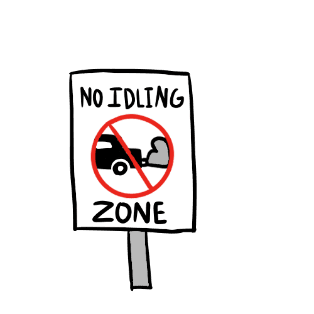
The City of London also enforces London’s Anti-idling By-law to help reduce pollution. The bylaw prohibits idling of vehicles for over 2 minutes, except for certain circumstances such as cold weather (less than 5°C) or hot weather (greater than 27°C) and when advised doing so by a doctor. This limit was revised in 2008 from the previous limit of 5 minutes. According to Natural Resources Canada’s Office of Energy Efficiency, if every Canadian motorist avoided idling their vehicle for just 5 minutes each day of the year, we could prevent more than 1 million tonnes of carbon dioxide from entering the atmosphere.
Reporting

Air pollution in Ontario comes from a combination of many different sources rather than one single contributor. Transportation is one of the largest sources of air pollution, with emissions from cars, trucks, and fuel-powered equipment creating pollutants such as nitrogen oxides, and particulate matter. Other sources include lawn and garden equipment, solvent use from homes and businesses, gas stations, auto body and printing shops, chemical products, paints, and other small industrial activities. Ontario’s electricity system is primarily powered by low-emission sources. In 2025, nuclear generation provided approximately 48% of Ontario’s electricity, while hydroelectric generation provided approximately 23%. Other sources included natural gas, wind, solar, and bioenergy. While nuclear and hydroelectric generation produce very low operational air emissions, natural gas generation can contribute to air pollution, particularly during periods of high electricity demand. For more information on Ontario’s electricity supply mix, visit the Independent Electricity System Operator (IESO) – Supply Mix and Generation. Air pollution can also travel into Ontario from other regions, including emissions from outside the province and the United States. In recent years, wildfire smoke has become an increasingly important contributor to short-term air quality concerns across Ontario. Reducing air pollution requires action across many areas, including cleaner transportation, improved energy efficiency, and reducing emissions
from everyday products and activities. For more information on environmental assessments in London, please go to https://london.ca/living-london/water-environment/environmental-assessments.
Municipal Action

The City of London’s Climate Emergency Action Plan outlines the community’s pathway to achieving net-zero greenhouse gas emissions by 2050. As required by the Province of Ontario, the plan uses 1990 as its baseline year for measuring emissions and tracking progress. By 2020, London had reduced its greenhouse gas emissions by approximately 30% compared with 2005 levels. For more information, visit here.
London has been a member of the Partners for Climate Protection being led by ICLEI – The International Council for Local Environmental Initiatives (now referred to as Local Governments for Sustainability) and the Federation of Canadian Municipalities (FCM). Since joining in 1994, London has completed the FCM’s five milestones. Over 2000 members across Canada are working with FCM’s ‘Partners for Climate Protection’ campaign to reduce community energy use and greenhouse gas emissions (GGE).
London is also part of the more recent International Compact of Mayors Agreement (2014) which merged in 2016 with the EU Covenant of Mayors to create the Global Covenant of Mayors for Climate and Energy, the largest global coalition of cities committed to climate initiatives to further advance local climate action. The coalition is made up of 13,800 cities and local governments across 148 countries working together to achieve the goals set in the 2016 Paris Climate Agreement.
Health Impacts of Air Pollution

Air pollutants and smog are, by definition, injurious to life and property. The primary impact in London from air pollution is on human health. Air pollution has shown to be a cause of disease, increased hospitalizations, and premature death. Smog can cause damage to your heart and lungs, and it can irritate your eyes, nose, and throat. Persons most at risk are those with respiratory problems, children and seniors, and those suffering from heart disease, lung disease or diabetes, but even healthy individuals who work or exercise outdoors in urban areas may be subject to health risks. Seniors generally feel more the negative health effects of smog, while children are more sensitive to it since their respiratory systems are still developing and they are often engaging in physical activity. Even healthy young adults have a harder time breathing in heavily polluted air.
Air pollution at all levels can impact human health. Even with relatively low levels of air pollution in Canada, research has shown it leads to disease, increased hospitalizations, and even premature death. In 2017, the International Institute for Sustainable Development reported that air pollution is responsible for 7,000 to 14,000 premature deaths every year. Their full report from 2017 can be read here. Air pollution is composed of a variety of substances with most health effects attributed to smog. A number of health risks are associated with air pollution. Breathing and lung conditions affected include asthma, allergies, and chronic obstructive pulmonary disease (COPD) and heart conditions affected include angina, arrhythmia, heart attack, hypertension, and health failure. Children, older adults, pregnant women, and those with existing heart and lung conditions are most vulnerable to the fine particulate components of smog. For more information, please refer to the Government of Canada website that details what the health risks are.
The Ontario Public Health Standards states that one of the mandatory programs/services that must be delivered to patients includes environmental health. In the report Assessing Health Vulnerability to Climate Change, data showed that health risks are increasing for people across North America as well as those in Middlesex Country and London because of climate change, and it stated that one of the risk factors is air quality.

While it is difficult to protect yourself from all forms of air pollution, the Residential Indoor Air Quality Guidelines are a great resource to protect yourself from contaminants in your own home. Road traffic air pollution is a concern in densely populated urban cities, but the majority pollutants come from greenhouse gas emissions from energy production and manufacturing industries. It is important to check the Air Quality Health Index for your region and limit time spent outdoors on days with higher risk.
Environmental Impacts of Air Pollution

Smog has also been found to damage forests, agricultural crops and natural vegetation. Smog-causing pollutants even contributes to corrosion of materials like rubber and stone. To see more information regarding environment and wildlife enforcement and how you can help refer to the page here from Environment and Climate Change Canada.
The importance of trees and vegetation is often overlooked. Even in your home, houseplants can support clean air. Trees trap dust, airborne particulate matter and ozone thereby improving air quality and human health and reducing smog. Since concrete and the lack of a natural ecosystem prevent trees from reseeding themselves in most parts of an overall urban forest, it becomes our job to continually plant new trees. Not only do they moderate air temperature, but through photosynthesis, their leaves take in carbon dioxide and release oxygen for us to breathe. Locally, ReForest London’s “Million Tree Challenge” has become a great success to provide support to the local community with tree planting. Planting trees is a proactive measure as we face the growing threat of climate change.
Examples of City initiatives include:
- Heating and cooling City Hall through London District Energy’s high-efficiency tri-generation system but the service is scheduled to be permanently cut off October 31, 2026
- Improving the energy efficiency of municipal buildings through energy performance upgrades.
- Creating and maintaining pollinator gardens and protecting environmentally significant areas such as the Central London Pathway.
- Expanding active transportation infrastructure, including cycling facilities and sidewalks.
- Transitioning portions of the City’s fleet to lower-emission vehicles, including compressed natural gas (CNG) trucks.
- Upgrading municipal facilities with energy-efficient LED lighting.
- Implementing the Climate Emergency Action Plan, which provides a roadmap to achieve net-zero greenhouse gas emissions by 2050

Find out more here at Get involved London
Federal Regulations
The federal government makes public federal legislation, guidelines, regulations and incentives specific to man-made polluting emissions and air quality. Information includes documents such as: Canada’s Energy Efficiency Act, the National Energy Board Act and Canada’s Regulatory Framework for Air Emissions. The federal site outlining and information and protection measures can be found here. Canada is part of the Paris Agreement (within the UNFCCC, it’s sets goals to combat climate change), which has established the objective to reduce emissions by 40 to 45 per cent by 2030 on the path to net zero emissions by 2050. The Emissions Reduction Plan is a requirement under the Canadian Net-Zero Emissions Accountability Act, which establishes regular milestones for tracking Canada’s progress. The Climate Action Tracker has more information on Canada’s progress towards the Paris Agreement.

The federal Canada Clean Air and Climate Change Act amended the Canadian Environmental Protection Act, 1999, the Energy Efficiency Act and the Motor Vehicle Fuel Consumption Standards Act (Canada’s Clean Air Act). This bill addresses and lays out national standards on air pollution as well as greenhouse gas emissions. Air pollutants from appliances (air conditioners, furnaces, heat pumps), which are associated with smog had been placed on a schedule of the Canadian Environmental Protection Act, 1999 (CEPA 1999) so control actions and preventative maintenance can be put in place to phase out and reduce these products.
The Montreal Protocol — an agreement to protect the stratospheric ozone layer by phasing out ozone depleting substances — globally agreed that developing countries would phase out 90% of HCFCs by 2015 and completely phase them out by 2020. In 2016, the Kigali amendment was passed to phase down production and consumption of HFC worldwide (CFCs are already controlled under this protocol). It has been confirmed that globally over 90% of ozone-depleting substances (ODS) have been eliminated. In Canada we have surpassed our target in the Kigali amendment by averting emissions exceeding 6,7 million tonnes of CO2, relative to Canada’s baseline consumption. With the success of the Montreal Protocol it is estimated that the ozone layer will return to pre-1980’s levels by 2050 as long as it continues to be implemented world-wide.
The Canadian Environmental Protection Act (CEPA) and Ontario Regulation 419/05, provides a list of pollutants of concern subject to legislative control and management and these are reported to the National Pollutant Release Inventory. This inventory identifies pollutants released, disposed of and recycled by Canadian facilities.
The federal Natural Resources Canada’s ‘Idle Free Zone’ provides fact sheets, resources and educational materials to promote personal vehicle idling reduction messages and campaigns.
Provincial Regulations

The Ontario Ministry of the Environment uses stringent regulations, targeted enforcement and a variety of innovative programs and initiatives to address environmental issues that have local, regional and/or global effects. Responsibilities include protecting air, land and water to ensure healthy communities, ecological protection and sustainable development for present and future generations.
While the government of Ontario retains the primary responsibility for environmental protection, the Environmental Bill of Rights (EBR) provides every resident with formal rights to participate in decisions being made on environmental issues. An Environmental Registry provides public access to notices on new or revised laws, regulations, policies and programs through government ministries covered by the EBR. The office of the Auditor General of Ontario is an independent, non partisan Office of the Legislative Assembly now responsible for monitoring government obligations under the EBR including the registry.

For air quality, the ministry oversees legislation and regulations that set strict air standards, facilitates Certificates of Approval to ensure companies operate within their limits, inspections and investigations of companies out of compliance with regulations and conditions of their Certificates of Approval and education and informing the public on ways to reduce air pollution and protect themselves from the effects of poor air quality.
The province has General Air Standards that outline the legal limits for contaminants present in the air. These standards mandate that facilities must have a lower concentration of contaminants in their air emissions than is present in the outside air. Facilities that cannot meet the general standard can request a site-specific standard. To do this they must go through the process of submitting all of the required reports to the ministry and the public, before a meeting with the public to explain their plans. Additionally their request will be put on the Environmental Registry for at least 45 days. If approved, the site-specific standards will last 5-10 years before they come up for renewal which will require most of the process to be done again. Additionally there is also the Code of Toxic Substances which is a federal-provincial list of toxic substances. These substances are categorized according to the criteria set forth by CEPA and the federal government’s Chemicals Management Plan (CMP).

Ontario also had mandatory Drive Clean emissions testing for vehicles (once a vehicle is five years old) and diesel-powered trucks and buses. Since April 1, 2019, Ontario drivers are no longer required to get Drive Clean emissions tests for light passenger vehicles, however emissions standards still apply to all vehicles. Heavy diesel commercial motor vehicles continue to require an emissions test. The ministry had an electric and hydrogen vehicles incentive program (EHVIP), as well, 5% ethanol in gasoline as of January 2007; which has now been raised to 10% in London. The ministry has environmental compliance reporting on excess contaminant discharges to air and water from industrial and municipal facilities regulated by the ministry.
As part of its commitment, the provincial government has updated its legislation (since 2005) on Air Quality (Regulation 419: Air Pollution – Local Air Quality) to protect local communities and reduce industrial emissions combining protective air quality standards with modern scientific methods and implementation tools. As decisions on air standards are made, the regulation is amended on air standard concentration limits for contaminants assessed using air dispersion models and/or ambient monitoring.

Ontario’s Climate Change Action Plan 2016-2020 includes: working on Canada wide standards for a low-carbon economy, creating a cleaner transportation system by increasing zero-emission vehicles, ensuring natural, agricultural and forest lands to be used efficiently to aid in greenhouse gas reductions.
A number of publications from the ministry are accessible to the public on their website. For example, the ministry‘s special air quality studies and their most recent Air Quality monitoring reports (2021).
Taking personal action

- Walk, ride a bike, carpool, take public transit, keep car in good repair
- Hold a teleconference or video call instead of traveling to meetings or arrange to telecommute from home as part of your work week
- Reduce the use of oil-based paints and glues, pesticides, air conditioners and gas-powered small engines, such as lawnmowers, chainsaws and leaf blowers
- Turn down air conditioners, turn off lights not needed, avoid aerosol sprays, don’t light up barbeques and reduce smoking
- Shut your car engine off, even for short stops – one minute of idling uses more fuel than restarting your engine. Avoid drive throughs and park instead. Drive at moderate speeds and check your tires regularly. Refuel your vehicle after sundown when air pollution levels are lower and gasoline vapours won’t add as much to the problem.
- Even in winter, the presence of fine particulate matter in the air can cause smog. To avoid winter smog, reduce car use and turn off your vehicle when parked.
- Consider fuel efficiency and emissions when buying a new vehicle by referring to Natural Resources Canada’s yearly fuel consumption guide (2024) which also includes vehicle greenhouse gas emission impacts
- Consider cars with reduced environmental impacts when buying such as green vehicles, hybrid and electric cars.
- Reduce energy use and learn more about alternative energy sources for your home. Keep your air conditioner at 25C+ or utilize ceiling fans or small fans instead.

- Do not burn leaves, branches or other yard waste. Limit the amount of wood you burn in your fireplace or wood stove. Use only dry, seasoned varieties of wood.
- Find alternatives to cleaning or personal aerosols that contribute to VOCs.
- Houseplants can help filter the air indoors, increasing indoor air quality and giving a calming effect to interior spaces
- Write letters to the media and politicians, consider joining a citizen’s committee to advocate for cleaner air in your community.
Business Directory
| Airia Brands Inc. | 511 McCormick Blvd, London 1-855-247-4200 www.lifebreath.com | Manufactures the Lifebreath line to develop, manufacture, and distribute products that will improve the quality of indoor air, while reducing energy costs and environmental impact. |
| Air Quality Solutions | 47 Frontier Dr, Niagara-on-the-Lake, ON L0S 1J0 1-844-247-8378 https://www.airquality solutions.ca/london/ | This company conducts air quality testing and environmental assessments with the goal of promoting healthy and sustainable indoor environments. |
| Canadian Environmental Law Association | 55 University Avenue, Suite 1500, Toronto, ON M5J 2H7 416-960-2284 1-844-755-1420 http://www.cela.ca/ | A legal aid clinic founded in 1970 to provide environmental equity, justice, and health. They provide free legal services relating to environmental justice in Ontario, representing low-income and vulnerable or disadvantaged communities in litigation to reduce barriers to improving sustainability and human health for the future. |
| Environment and Climate Change Canada, Public Inquiries Centre | Fontaine Building 12th floor 200 Sacré-Coeur Blvd Gatineau QC K1A 0H3 819-938-3860 1-800-668-6767 ministre-minister@ec.gc.ca https://www.canada.ca/ en/environment-climate-change/corporate/contact.html | The federal Ministry of Environment that enacts all environmental federal policy changes, protects and conserves our natural heritage, promotes a sustainable environment for future generations, as well as predicting weather and environmental conditions. |
| International Institute for Sustainable Development | 220 Laurier Ave W, Ottawa, ON K1P 5J6 +1-204-958-7700 info@iisd.org https://www.iisd.org/ articles/insight/ environmental-protection-boosts-productivity | A charitable organization working to create a world where people and the planet thrive by accelerating solutions for a stable climate, sustainable resources, and fair economies. |
| London Environmental Testing Services | Unit 11 – 1673 Richmond Street, Suite 629 London, ON N6G 2N3 226-646-4144 info@london environmental.ca https://london environmental.ca/iaq.php | This company provides a variety of indoor air quality services to ensure that their customer’s indoor air quality is up to par and promotes good health. |
| Lung Health Foundation | 18 Wynford Drive, Suite 401, Toronto, ON M3C 0K8 416-864-9911 1-888-344-5864 info@lunghealth.ca https://lunghealth.ca | Works to improve Canada’s overall lung health through prevention and diagnosis of lung disease. They also empower those with lung disease through community education, research, and advocacy to foster compassion for those with lung disease and their families. |
| Middlesex-London Health Unit | 355 Wellington St, London, ON 519-663-5317 https://www.healthunit. com/ | Identifies public health concerns to promote healthy living and address community needs. Conducts health inspections, in-school clinics, and research to work with local politicians to create bylaws and guidelines that lead to healthier communities across London. |
| Ontario Clean Air Alliance | 160 John Street, Suite 300 Toronto, Ontario, M5V 2E5 416-260-2080 contact@cleanairalliance.org http://www.cleanair alliance.org | Led the campaign that resulted in Ontario phasing out all of their coal-fired power plants. Now they are pushing Ontario towards a 100% renewable energy future through energy conservation and efficiency, Made-in-Ontario green energy, and a possible cooperation with Hydro Quebec. |
| Purifics Water Inc. | 340 Sovereign Rd, London 519-473-5788 www.purifics.com | Produces high-capacity ceramic membrane air and water purification systems for the reuse market, municipal, industrial and global markets. |
| ReForest London | 944 Western Counties Rd, London, ON N6C 6A9 +1-519-936-9548 info@reforestlondon.ca https://www.reforest london.ca/resources/ benefit-of-trees/ | A registered charity dedicated to preserving and expanding the urban forests of the region by engaging citizens in hands-on tree planting and care, they foster a sense of ownership and pride in London’s urban forest, empowering individuals to be proactive stewards of our natural resources. |
| Southwestern Public Health | 1230 Talbot St, St Thomas, ON N5P 1G9 1-800-922-0096 1-800-922-0096 https://www.swpublic health.ca/en/community-health/outdoor-air-quality.aspx | This organization is a great resource for environmental health information and recommendations regarding health impacts from air quality, climate change, and more. |
| The Weather Network | 2655 Bristol Cir, Oakville, ON L6H 7W1 +1-905-829-1159 https://www.theweather network.com/ca/ historical/ontario/london | This company is the number one source of weather information in Canada, their content can be found on their specialized channel on TV, as well as on their website or in their app. They provide historical, current, and future weather prediction data to the public. |
| The World Air Quality Index | 15 Tommy Hunter Way, London, ON N5Z 2R1 Email Form https://aqicn.org/city/ canada/ontario/london/ | A non-profit project with the goal of increasing air pollution world-wide through being a resource for consolidated air quality information from many participating cities around the world. |